Medically reviewed by Dr. Yujal Man Singh, MD (Psychiatry) · Updated 20 September 2026
Attention-deficit hyperactivity disorder (ADHD) is a lifelong difference in attention, activity and self-control that starts in childhood. Many adults were never diagnosed as children. A careful assessment, followed by medicine, skills and support, helps most people focus better and feel more in control.
Book a consultation WhatsApp to book
Common signs in teenagers and adults
- Losing focus quickly, missing details, careless mistakes
- Starting many tasks, finishing few; putting things off until the last minute
- Losing keys, phone or documents often
- Restlessness, talking over others, acting on impulse
- Trouble with time, deadlines and money
Many people with ADHD also struggle with anxiety, low mood, poor sleep or substance use, and these need attention too.
How ADHD is assessed
There is no single blood test or scan for ADHD. Assessment means a detailed talk about your childhood and present life, rating scales, and where possible information from a parent, partner or old school reports. Other causes of poor focus, such as depression, anxiety, thyroid problems or poor sleep, are checked first.
How the assessment is adapted for Nepali patients
Most ADHD questionnaires were written and tested on adults in Europe and North America. Used word for word in Nepal they can mislead, so the assessment here is adjusted in several ways.
- Nepali, not translated on the spot. Rating scales are gone through in Nepali or English, whichever you think in, with each item explained rather than read out. A question such as “how often do you fidget with your hands or feet” means little until it is put in terms of your own day.
- Childhood evidence without school reports. ADHD has to have started in childhood, and in the West that is checked against old school reports. Most Nepali adults do not have these, and classes of sixty with rote learning hid a great deal. Instead we rely on what parents, older siblings and relatives remember, which in Nepali families is usually a lot.
- Family as informants, which fits how most people live. Joint and extended households mean someone has usually watched you closely for years. That account is more useful than any questionnaire score.
- Separating ADHD from the life you are living. Long shifts, night duty, study abroad, loan pressure and poor sleep all produce poor concentration. These are checked before any diagnosis, because treating them is often what actually helps.
- Scores are a guide, not a verdict. No questionnaire diagnoses ADHD. The numbers sit alongside your history, not above it.
Assessment is available in Nepali, English or Hindi, in Kuleshwor or by video if you live outside Kathmandu or abroad.
How ADHD is treated
A large network meta-analysis in Lancet Psychiatry (133 trials) found that ADHD medicines reduce core symptoms in children, adolescents and adults. It supported methylphenidate as a first choice in children and adolescents, and stimulant medicines in adults, while noting that tolerability differs between drugs [1]. Availability of specific medicines in Nepal varies, and choices are discussed with you.
- Medicine, started at a low dose and reviewed regularly
- Practical skills: planners, reminders, breaking tasks into steps
- CBT for procrastination, low self-esteem and anxiety
- Support for families and partners
Therapy and skills: the main part of treatment
Medicine can turn the symptoms down. It does not teach anyone how to plan a week, start a task they have been avoiding, or stop a day falling apart by eleven in the morning. Those are learned skills, and for adults they are where most of the work in treatment goes.
The evidence for this is good. In a randomised trial of 86 adults who were already taking medicine but still struggling, twelve sessions of cognitive behavioural therapy were compared with a relaxation and education programme of the same length. Two out of three improved on the ADHD rating scale, against one in three in the comparison group, and those who improved still held their gains a year later [2].
The programme used here
Dr. Yujal works from Mastering Your Adult ADHD: A Cognitive-Behavioral Treatment Program (second edition, Oxford University Press), using the Therapist Guide in session and asking clients to get the Client Workbook so they can follow along and keep their own worksheets. It is a structured programme rather than open-ended talking, and it covers:
- Organisation and planning: one calendar and one task list instead of five, and breaking large jobs into first steps small enough to actually start
- Attention management: working in short blocks, cutting distractions, and learning your real attention span rather than the one you wish you had
- Adaptive thinking: catching the thoughts that turn one missed deadline into giving up on the whole week
- Procrastination, which is treated as a habit to be worked on, not a character flaw
- Optional sessions with a partner or family member, so the people around you understand what helps
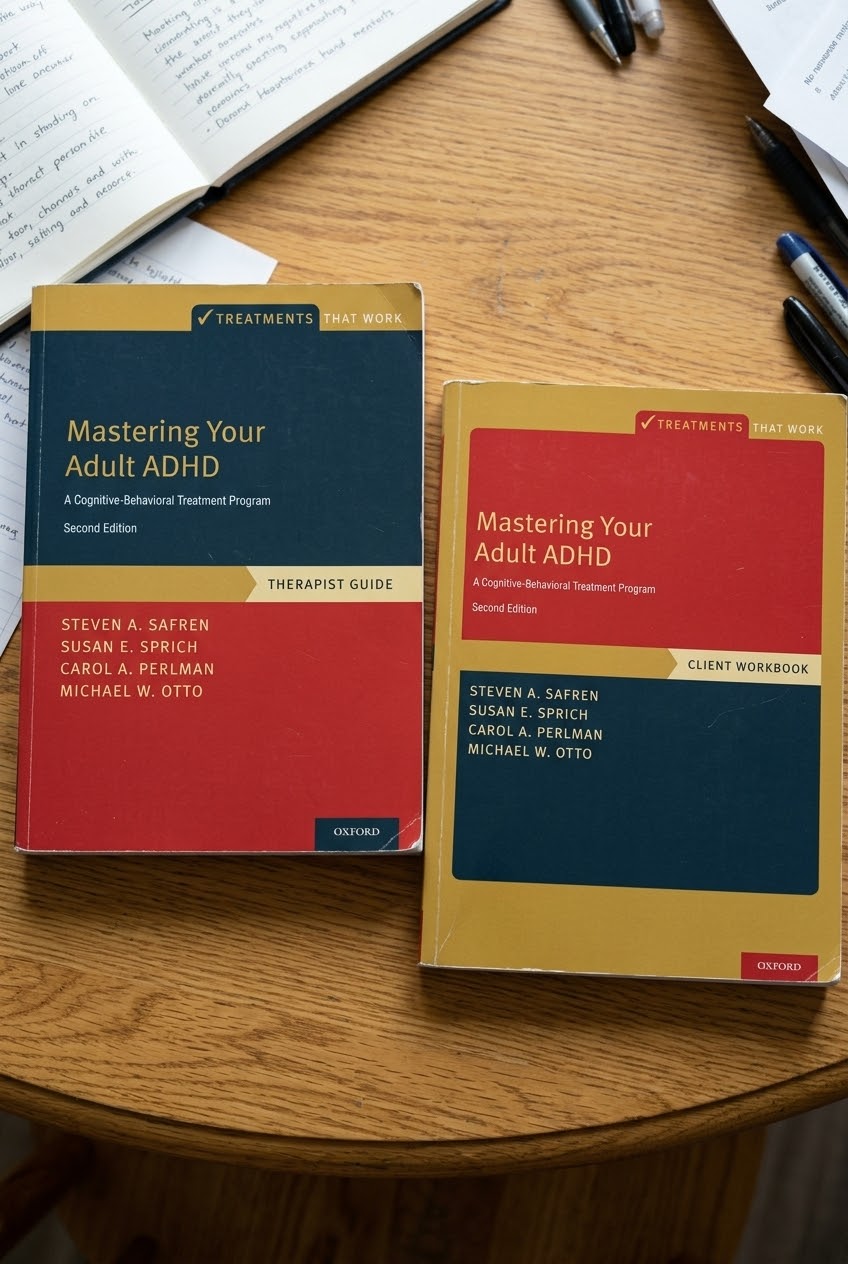
Alongside the workbook, sessions use TEAM-CBT, which measures how you feel at the start and end of every session. With ADHD this matters more than usual, because progress is easy to lose track of. If the numbers are not moving, the plan changes.
If you want to see how this approach is used before booking, there is a free webinar, Mastering Your ADHD with Carmen Enciso Steinberg, LMFT, on the TEAM-CBT Training channel.
What helps, with or without a therapist
- One calendar for everything, checked at the same time each day
- Write the next physical step, not the goal. Not “sort out the visa”, but “find the passport”
- Use alarms and deadlines instead of relying on remembering
- Protect sleep. Short sleep makes every ADHD symptom worse, and is often the easier thing to fix first
- Regular exercise, which helps attention and mood even when nothing else has changed
Which ADHD medicines are used in Nepal
Two groups of medicine are used. Stimulants, such as methylphenidate, act quickly and are the better studied of the two. Non-stimulants, such as atomoxetine, work more slowly but suit people who cannot take a stimulant. Both are prescription only and need review by a psychiatrist.
Which brands reach Kathmandu pharmacies changes from month to month, so the honest answer to what is available in Nepal is that it varies. At the appointment you will be told what can be obtained at that time, and what the alternatives are if a brand runs out.
Please do not buy ADHD medicine online, borrow it from someone else, or carry it across a border without checking that country’s rules first. Several countries, including Japan and the Gulf states, control these medicines strictly.
Is it ADHD, or something else?
Poor focus is common, and ADHD is only one cause of it. These are checked before any diagnosis is made:
- Sleep. Long hours, night shifts and untreated sleep problems can look very much like ADHD.
- Depression and anxiety, which both make concentration difficult and are treatable.
- Thyroid problems and anaemia, which a blood test can settle.
- Alcohol and drug use, and very heavy screen use.
ADHD is diagnosed when the pattern began in childhood and has caused real difficulty in more than one part of life, not when focus has been poor only for the past few months.
What to bring to your assessment
- School reports, or anything written about you as a child, if you still have them
- A parent, partner or close friend, or their phone number, because another person’s account of you matters
- A list of the medicines you take now
- Examples of where focus breaks down: work, study, driving, money, relationships
The first appointment takes about an hour. A diagnosis is not always made on the first visit. Sometimes a second appointment, information from family, or a blood test is needed first.
ADHD when you live abroad
Many Nepalis abroad first wonder about ADHD when study or shift work becomes hard to manage. The assessment can be done online, in Nepali or English, at a time that suits your time zone. Where medicine is needed, Dr. Yujal can write to your local doctor with the assessment so it is prescribed where you live, because carrying these medicines across borders is restricted in many countries. See care for Nepalis abroad.
Seeing Dr. Yujal in Kathmandu or online
Dr. Yujal Man Singh is a psychiatrist at Mind Matters Nepal in Kuleshwor, Kathmandu. You can meet him in person or by video call from anywhere in Nepal or abroad. Sessions are in Nepali, English or Hindi. No referral is needed.
Filling in the Brief Mood Survey (BMS) form before and after each session is a must, so we can both see how you are doing.
Book a consultation WhatsApp to book
Common questions
Can adults have ADHD?
Yes. ADHD starts in childhood, but many people are first diagnosed as adults, often when work or study demands increase.
Do you see children with ADHD?
Dr. Yujal sees teenagers aged 13 and above and adults. For younger children, a child psychiatrist or paediatrician is the right first step.
Can ADHD be assessed online?
Much of the assessment can be done by video call. Some people may need an in-person visit or local tests before medicine is started.
In a crisis? This clinic does not provide emergency care. If you or someone near you may act on thoughts of suicide or is in danger, go to the nearest hospital emergency or call 1166 (Nepal suicide prevention helpline). Abroad, call your local emergency number.
Research behind this page
- Cortese S, et al. Comparative efficacy and tolerability of medications for attention-deficit hyperactivity disorder in children, adolescents, and adults: a systematic review and network meta-analysis. Lancet Psychiatry 2018;5(9):727-738. doi:10.1016/S2215-0366(18)30269-4
- Safren SA, Sprich S, Mimiaga MJ, et al. Cognitive behavioral therapy vs relaxation with educational support for medication-treated adults with ADHD and persistent symptoms: a randomized controlled trial. JAMA 2010;304(8):875-880. doi:10.1001/jama.2010.1192