What to expect at your first psychiatrist appointment, and after
What happens in your sessions
Seeing a psychiatrist can feel like a big step, especially when you don’t know what will happen. Here is the whole journey, from the first session to the last.

How do I prepare for my first appointment?

- In person: come a few minutes early to the clinic in Kuleshwor, Kathmandu.
- Online: we meet on a video call. Find a quiet, private place and use headphones if you can.
- Bring old prescriptions, medicine names and reports if you have them.
- You can bring a family member or friend. You decide how much of the session they join.
- You don’t need to prepare what to say. Many people arrive not knowing where to start, and that’s fine.

How long is a session?
Most sessions are 1 hour. Some run 1.5 or 2 hours, or longer. A longer session gives us time to finish working on something important instead of stopping halfway, and sometimes a lot changes in one longer session. We agree on the length before we begin.

A short mood check, every time
Before each session you fill in a 2 minute form. It asks how sad, anxious, angry or hopeless you feel right now, and how happy you are in your close relationships. It also asks about thoughts of ending your life. We ask everyone this, and it is safe to answer honestly.
At the end you fill it in again, so we can both see what changed. You also rate the session: did I listen, did I understand you, did it help. Low scores help me most. A 2018 review of feedback studies found that therapy goes better when progress is checked like this every session.
What happens at the first appointment?
The first session is about getting to know you as a person, not just your symptoms. I’ll ask about:
- what brought you here, and when it started
- how it affects your sleep, appetite, work, study and relationships
- whether you’ve felt like this before, and what treatment you’ve had
- your physical health and medicines
- your family, growing up, school, work and marriage
- alcohol, smoking or other substances
- your strengths, and what has helped you cope
Before trying to help, I want to understand what this has been like for you.
Go at your own pace. You can say “I’m not ready to talk about that yet.” Crying is normal here. My main job in this session is to listen and understand what this has been like for you. A 2018 review and an earlier study by Dr. David Burns both found that feeling truly understood is strongly linked to getting better.
Near the end I’ll explain what I think is going on in simple words, and we’ll agree on a plan: therapy, medicine, or both. You’ll have time to ask anything.
What happens in each session after that?
Each session follows the same shape. Watch the short animation, or read the steps below it.
Plays by itself when you reach it. Tap to pause.
-

Mood check, then listening
We look at your scores together. Then you tell me what has been hardest since we last met. I won’t rush to fix it. I’ll check I’ve understood before we move on.
-

You choose what to work on
I’ll ask if you want help with this today, and with what exactly. It helps to bring one specific moment, like “Tuesday evening, when my husband didn’t reply.”
-

The other side of your feelings
I may ask what your painful feelings say about you that is good. This surprises people. Worry can show how much you care. Guilt can show your values. Then you decide how much you want each feeling to come down. It doesn’t have to be to zero. You stay in charge of how much you change.
-

Working on one moment
We write down the upsetting thoughts and how strongly you believe them, then test them. Is it true? Would you say it to a friend? I may play your negative thoughts while you answer back. For fears, we plan small steps to face them. The goal is not positive thinking. It is thoughts that are true and that you actually believe.
-

Mood check and your feedback
You fill in the mood check again and rate the session. If something didn’t help, this is where you can say so.
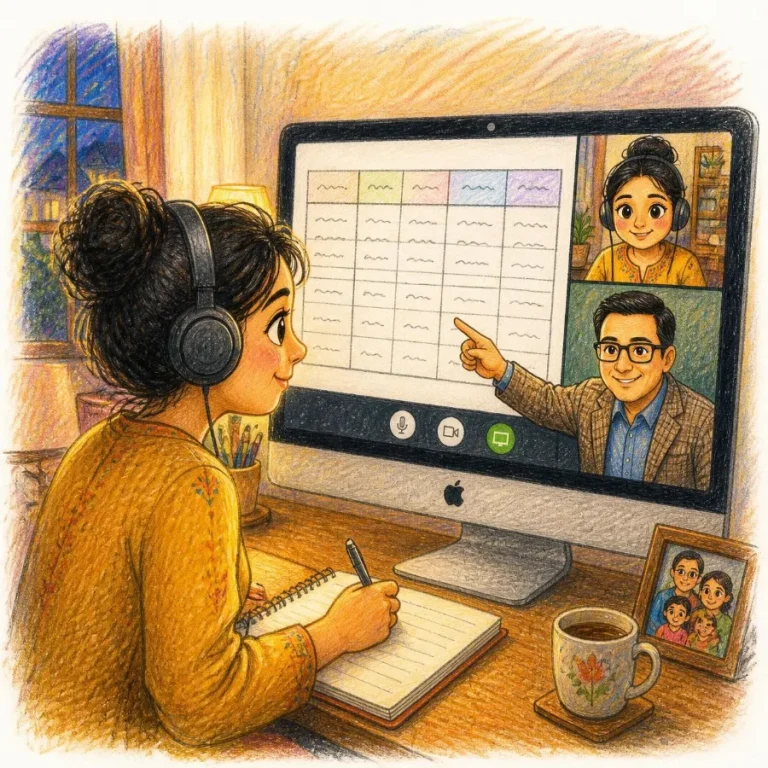
Online sessions
Online sessions follow the same steps. I share the mood log on screen and we fill it in together, wherever you are. A 2021 review comparing video and in-person therapy found similar results for both.
What do I do between sessions?

I’ll suggest something to practise, usually 15 to 20 minutes a day. Often this is a mood log, a worksheet for working through an upsetting moment on your own. I’ll give you private access to it online.
People who practise between sessions tend to improve more. This was found in an early study by Dr. Burns and confirmed in a 2016 review of many studies. If you don’t manage it one week, that’s okay. We’ll talk about what got in the way, without blame.

How progress usually looks
Progress isn’t a straight line. Some people make a big change from one session to the next, which researchers call a sudden gain. Others improve slowly. Because we check your mood every session, we can both see what is really happening and change the plan if something isn’t working.
Facing fears or painful memories can make you feel worse for a short time before you feel better. Please tell me if this happens.
How does therapy end?

When your scores are low and stay low, we plan the end together. We’ll:
- look back at what helped most
- write down your early warning signs
- practise what to say to yourself when bad days come back, because they will
- plan what to do if things slip, including a booster session
A 2005 study found the benefits of CBT tend to last after therapy stops.

Your privacy
What you share stays between us. The rare exceptions are a serious risk to your life or someone else’s, or when the law requires it. If that happens, I’ll talk to you first wherever I can. When family is present, you decide what is shared.
Questions people ask before their first visit
 What should I say at my first psychiatrist appointment?
Say what is bothering you in your own words. There is no right way to start. It helps to jot down three things before you come: what changed, since when, and how it affects your sleep, work or relationships. Add any medicines you take. Nothing you say will shock me, and I will guide you with questions.
 Will I be given medicine at the first visit?
Not always. Medicine is suggested only when it is likely to help, and only after we talk it through. Many people start with therapy alone. If medicine makes sense, I explain why, what to expect and for how long, and you decide.
 Is it normal to feel nervous before the first appointment?
Yes, very normal. Most people feel nervous, and many almost cancel. You can tell me you are nervous at the start. The first few minutes are just about settling in.
 How many sessions will I need?
It depends on the problem and the person. Many people notice change within a few sessions, and others need longer. A 2020 review of routine therapy services found the same. We’ll look at your scores together and decide.

 Is online as good as in person?
Studies comparing therapy by video and in person find similar results. Many people living abroad prefer it.

Will I need medicine too?
Sometimes. For depression and some anxiety problems, a 2014 review found therapy plus medicine often works better than medicine alone. As a psychiatrist I can advise on both, and we decide together. Every medicine is explained.

 Does this work for Nepali people?
Yes. A 2016 review found therapy works across cultures, and works better when adapted to your language, beliefs and family life. Sessions can be in Nepali, English or Hindi, and your family and faith are welcome in the conversation.

 What if I don’t know what to say?
That’s common. I’ll guide you with questions. Silence is fine too.

 Can my family come?
Yes, for part of a session if you want. You decide what they hear.

 What about teenagers?
I see young people from age 13. Parents usually join part of the first session. The rest is private, with the same safety exceptions.

 What if I don’t feel comfortable with you?
Please tell me, on the feedback form or in person. It won’t upset me, and it helps. If we’re not a good fit, I’ll help you find someone who is.

 How do I book and pay?
Message on WhatsApp (+977 9851347591) or fill in the booking form. We find a time that suits you, in your own time zone if you live abroad, and tell you the fee. You can pay by card through a secure Khalti link, by bank transfer (SWIFT), or a family member can pay in Nepal by Fonepay, eSewa or Khalti. Please pay before the session to confirm it. More details are on the online consultation page.
 What if I need to cancel?
Please give at least 24 hours’ notice by WhatsApp or phone.

Myths, and what’s true
Swipe across, and tap a card to turn it over.
 Myth
Myth“Seeing a psychiatrist means I’m mad (paagal).”
Tap to see what’s truePeople come for stress, sleep problems, worry, sadness and relationship troubles. Asking for help is a sign of strength.
 Myth
Myth“Therapy is just talking.”
Tap to see what’s trueCBT is structured, and you learn skills you take home. A 2012 review of over 250 reviews found good results across many problems.
 Myth
Myth“It’s just positive thinking.”
Tap to see what’s trueWe look for thoughts that are true, not just pleasant. If a thought doesn’t ring true to you, it won’t help.
 Myth
Myth“It ignores my past.”
Tap to see what’s trueYour history helps explain why certain thoughts hit so hard. That’s why the first session goes into your past and family.
 Myth
Myth“It takes years.”
Tap to see what’s trueUsually not. Many people improve within weeks to months, as a 2020 review found.
 Myth
Myth“If I’m struggling, it isn’t working.”
Tap to see what’s trueHard sessions are normal. They often mean we’ve reached something important.
 Myth
Myth“I’ll be judged or told what to do.”
Tap to see what’s trueYou decide what to work on and how much to change. I bring the map. You steer.
 Myth
Myth“Once therapy stops, the problems come back.”
Tap to see what’s trueNot necessarily. A 2005 study found the benefits of CBT often last. You leave with your own umbrella.
Studies mentioned
- Lambert MJ, et al. Collecting and delivering progress feedback. Psychotherapy, 2018. PubMed
- Elliott R, et al. Therapist empathy and client outcome. Psychotherapy, 2018. PubMed
- Burns DD, Nolen-Hoeksema S. Therapeutic empathy and recovery from depression. J Consult Clin Psychol, 1992. PubMed
- Burns DD, Nolen-Hoeksema S. Homework compliance and the effectiveness of CBT. J Consult Clin Psychol, 1991. PubMed
- Kazantzis N, et al. Homework compliance and outcome in CBT. Behavior Therapy, 2016. PubMed
- Tang TZ, DeRubeis RJ. Sudden gains in cognitive therapy of depression. J Consult Clin Psychol, 1999. PubMed
- Hollon SD, et al. Prevention of relapse after cognitive therapy. Arch Gen Psychiatry, 2005. PubMed
- Robinson L, et al. The dose-response effect in routine psychological therapies. Psychotherapy Research, 2020. PubMed
- Fernandez E, et al. Live psychotherapy by video versus in-person. Clin Psychol Psychother, 2021. PubMed
- Cuijpers P, et al. Adding psychotherapy to antidepressant medication. World Psychiatry, 2014. PubMed
- Hall GCN, et al. Cultural adaptations of psychological interventions. Behavior Therapy, 2016. PubMed
- Hofmann SG, et al. The efficacy of CBT: a review of meta-analyses. Cognit Ther Res, 2012. PubMed